
Often our clients ask us where they can experience the real Tuscany — the one they’ve seen in photographs and travel books for years. Rolling hills, cypress-lined roads, stone farmhouses, quiet villages and long lunches that stretch into the afternoon. Many are surprised when we point them towards Val d’Orcia, a relatively small area in southern Tuscany that quietly ticks all the boxes without feeling overrun or staged, making it ideal for private tours Tuscany focused on authenticity rather than crowds.
This is the Tuscan countryside people recognise instantly, even if they don’t always know its name.
Quintessential Tuscan Countryside: Rolling Hills & Vineyards
Val d’Orcia lies south of Siena, between gentle farmland and the slopes of Mount Amiata. While it’s
officially a UNESCO World Heritage Site, what makes it special is not the label but the fact that it’s still a working landscape.
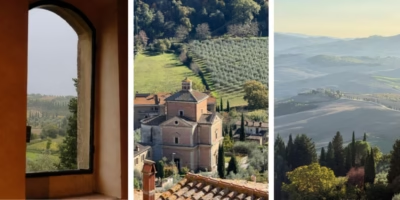
Fields are cultivated, vineyards are harvested, and villages are lived in year-round. The scenery hasn’t been designed for visitors; it’s the result of centuries of agricultural life shaped by practical needs and Renaissance ideals of balance and proportion. That’s why it feels so familiar — and so calm. Unlike some parts of Tuscany where tourism has reshaped daily life, Val d’Orcia has managed to absorb visitors without losing its identity.
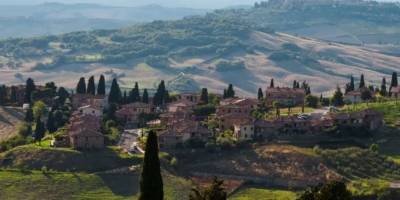
Experiencing the Laid-Back Tuscan Country Life Firsthand
One of the first things travellers notice here is the pace. Days aren’t driven by tight schedules or long lists of sights. Instead, they unfold gradually — a drive through the hills, a coffee in a small square, lunch that starts early and finishes when it finishes.
This is a part of Tuscany that rewards travellers who are happy to slow down. Time is better spent noticing how the light changes across the landscape, or how quiet the roads become once day visitors leave. For many of our clients, Val d’Orcia offers a welcome contrast to the busier cities on their itinerary — a chance to settle in rather than move on.
Tuscan Villages That Still Feel Lived In
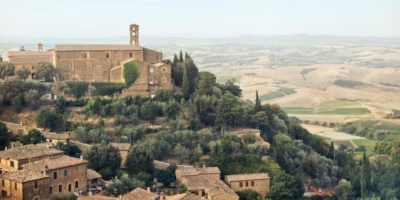
Val d’Orcia isn’t about one headline destination. It’s a collection of small towns and villages, each with its own character and rhythm.
- Pienza is compact and easy to explore, known for its harmonious Renaissance layout and local
pecorino cheese. It’s a place to wander rather than tick off sights. - Montalcino sits higher and feels more substantial, with wide views across the countryside and a
strong connection to wine production. Despite its reputation, it still feels grounded and local once
you step away from the main streets. - San Quirico d’Orcia is quieter again — ideal for a short walk, a relaxed lunch and a sense of
everyday life. - Bagno Vignoni is unusual and memorable, with its thermal waters forming the heart of the village
rather than being hidden away.
None of these places need to be rushed. In fact, they’re best experienced by choosing just one or two and spending real time there.
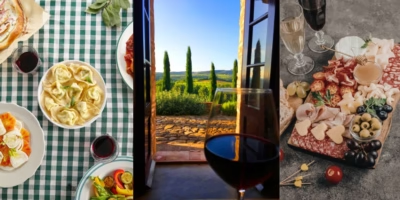
The Place to Try Authentic Tuscan Food and Wine Without the Fuss
Food in Val d’Orcia is honest and seasonal. Menus follow what’s available locally rather than trends, and meals are built around simple combinations done well.
The area is best known for Brunello di Montalcino, but wine here isn’t about formal tastings or technical language. A private wine tour Tuscany experience is about understanding the land, meeting the people who work it, and enjoying a glass at the table where it truly belongs.
The same goes for pecorino cheese, olive oil and handmade pasta — produced nearby, served without embellishment, and enjoyed slowly. This is countryside cooking that doesn’t try to impress, and doesn’t need to.
Where We Recommend Staying
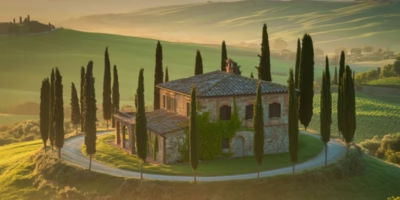
Accommodation in Val d’Orcia tends to be found outside the towns, in restored farmhouses, country estates and small villas. These are places chosen for their setting rather than their scale.
Staying in the countryside allows guests to experience Val d’Orcia at its best — early mornings when the hills are quiet, and evenings when the light softens and day-trippers have gone.
Comfort matters, of course, but here luxury is more about space, privacy and location than facilities.
The Best Way to Experience Val d’Orcia
Over the years, we’ve found that the most memorable experiences in Val d’Orcia are often the simplest ones:
- Scenic drives with no fixed timetable
- Visiting a winery where the owner is still involved day to day
- Walking through a village with a local guide who actually lives there
- Lunch that lasts longer than planned
- A thermal soak at the end of a day outdoors
Trying to fit too much in is usually the mistake people make. Val d’Orcia isn’t about maximizing activities — it’s about giving yourself time to enjoy where you are.
When to Visit Val d’Orcia
Spring and autumn are particularly well suited to this part of Tuscany. The weather is mild, the countryside is active, and the roads are quieter.
Summer can also be beautiful, especially for travellers staying in rural properties with space and shade. In these months, it’s best enjoyed as a place to slow down rather than sightsee.
Val d’Orcia works well for travellers who value atmosphere over attractions and prefer a more natural rhythm to their days.
Visit Val d’Orcia on a Bespoke Tour Designed by Local Experts
Val d’Orcia is not a place that lends itself to generic itineraries. Distances are short but experiences are nuanced, and knowing where to stay, when to visit, and how to pace each day makes a significant difference.
Our approach is shaped by local knowledge and years of planning journeys across Tuscany. We design bespoke tours that focus on the right balance — choosing locations that feel authentic, avoiding unnecessary movement, and opening doors to experiences that aren’t always easy to access independently.
With careful planning, Val d’Orcia often becomes the part of a journey that feels the most natural and unforced. Not because it’s dramatic or showy, but because everything flows easily — allowing travellers to experience the Tuscan countryside as it’s meant to be lived.
If this sounds like the Tuscany you’re looking for, get in touch today! We’d be happy to design a Val
d’Orcia itinerary tailored entirely to how you travel.
👉 Contact us today to plan your 2026 vacation in Tuscany—filled with flavor, culture, and unforgettable moments.

